New Construction Dumpster Guide for Northwest Arkansas Builders
Northwest Arkansas is building new homes at a fast clip. Here is how builders and homeowners can size containers by build phase, schedule swaps, and keep an active jobsite moving.
ReadSizing Guides guide
Shingles are dense enough that a roll-off's weight limit, not its volume, decides the right size. Here is the tonnage math for three-tab and architectural tear-offs, single and double layer, worked all the way through.
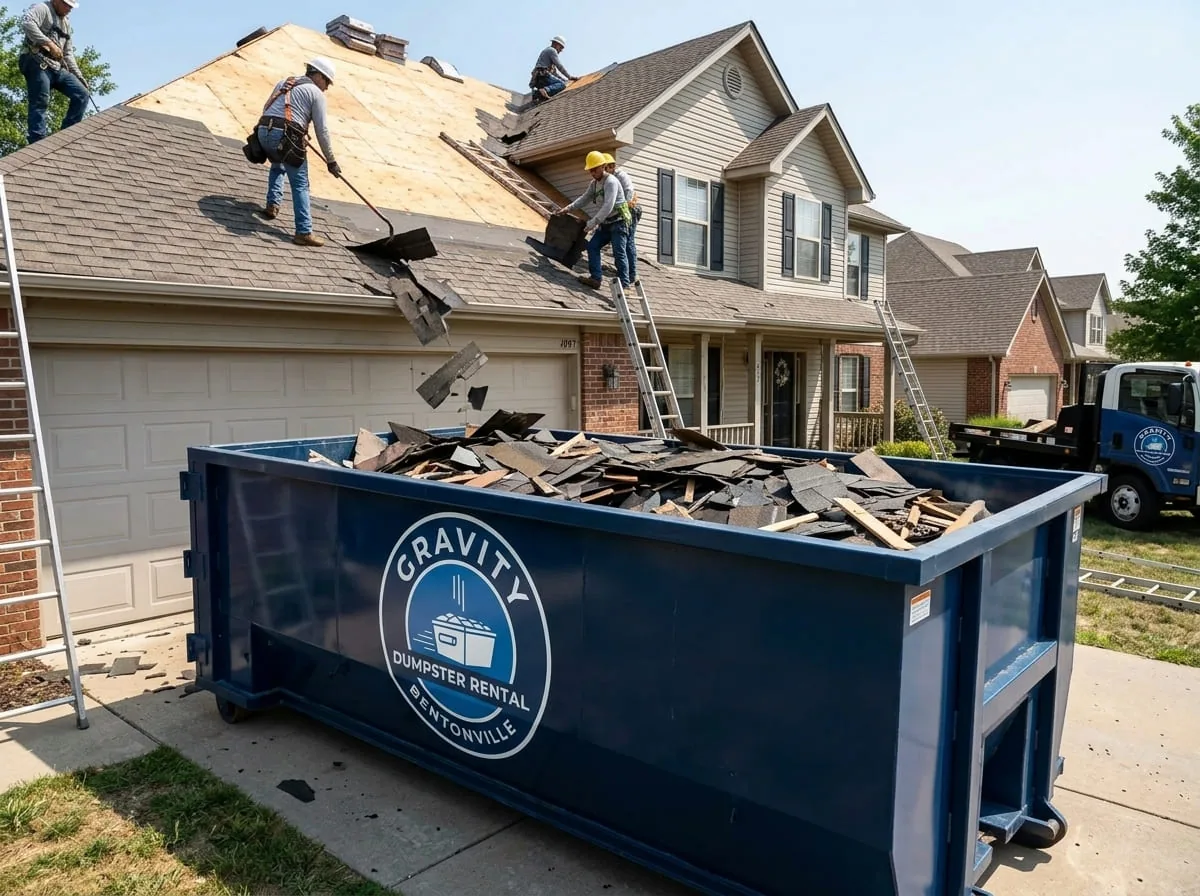
Roofing debris is the one job where guessing the container size by eye gets contractors and homeowners in trouble more than any other project type. A 20-yard box looks plenty big for a pile of shingles — and it is, by volume. The problem is weight. Shingles are dense, and a roll-off dumpster's rental price is built around a tonnage allowance, not a cubic-yard limit. Order the wrong size for a tear-off and you either pay overage fees on a container that still has visible room left in it, or you rent something oversized and pay for space you never needed. The fix is doing the math before the truck shows up.
Most residential debris — drywall, cabinets, old furniture, yard trimmings — is bulky and light. Shingles are the opposite: dense and compact. A stack of shingle bundles takes up a fraction of a dumpster's floor space but can max out its weight allowance long before the container looks full. That is why sizing a roofing dumpster by square footage of roof, not by the size of the container that "looks right," is the only approach that holds up. Get the tonnage estimate close and the size choice follows directly from the standard container sizes a company like a roofing dumpster rental service actually stocks.
The single biggest variable in roofing debris weight is which shingle type is coming off, and the two are not close. Standard three-tab asphalt shingles run roughly 230 to 250 pounds per square (a square is 100 square feet of roof). Architectural, or laminated, shingles — the thicker, dimensional style that has largely replaced three-tab on newer builds — run roughly 350 to 430 pounds per square. That is nearly double the weight of three-tab, square for square, and it is the reason a sizing estimate that just says "shingles" without specifying the type is not a useful estimate at all. Before ordering, know which one is coming off the roof, or confirm with whoever is doing the tear-off.
A "square" in roofing is 100 square feet of roof surface, not of the house's footprint — pitch matters, since a steep roof has more actual surface area than its footprint suggests. Most roofers or their estimate sheets will list square count directly; if you only have the footprint, a rough rule is to add roughly 10 to 30 percent for pitch depending on how steep the roof is, more for cut-up roofs with lots of valleys and dormers. Single-family homes in the Bentonville area commonly run somewhere in the range of 15 to 30 squares depending on footprint and roofline complexity, though larger two-story homes and anything with a complicated roofline can run higher. If there is any doubt, get the number from whoever quoted the roofing job rather than eyeballing it from the ground.
It also helps to know whether the whole roof is coming off in one pass or in sections. Some crews strip an entire roof deck before the first bundle of new shingles goes down, which means the full tonnage estimate lands in the dumpster over a single day or two. Others work section by section on a large or steep roof, tearing off and re-decking one plane at a time. That does not change the total weight coming off the house, but it can change how quickly the container fills and whether a mid-job swap makes sense on a job that is already close to a size boundary.
The math is simple once the square count and shingle type are known: squares multiplied by pounds per square, divided by 2,000, gives tons. Here is how that plays out across the jobs contractors see most often.
A 20-square three-tab, single-layer tear-off: 20 squares × 230–250 lb = 4,600–5,000 lb, or 2.3–2.5 tons. That lands squarely in a 20-yard dumpster's 2–3 ton allowance.
A 20-square architectural, single-layer tear-off: the same 20 squares at the heavier density comes to 20 × 350–430 lb = 7,000–8,600 lb, or 3.5–4.3 tons. That is a full class above the three-tab version of the same roof, and it pushes past a 20-yard entirely and into 30-yard territory — with the top of that range brushing up against what even a 30-yard is rated to carry.
A double-layer tear-off — a second roof installed over the first without stripping it, which was common practice for years — roughly doubles the weight since the crew is pulling two full courses of shingles off the same roof. Double-layer three-tab on a 20-square roof runs 9,200–10,000 lb, or 4.6–5.0 tons, which is right at the ceiling of a 40-yard's 4–5 ton allowance. Double-layer architectural on the same 20 squares runs 14,000–17,200 lb, or 7.0–8.6 tons — more than even a 40-yard container is rated to hold in one load. That is not a sizing problem a bigger box solves, because a bigger box is not offered at that weight class; it is a job that needs either a mid-project swap or two separate pulls, and it is worth flagging to whoever is quoting the tear-off before the container ever gets dropped. The table below lays out each of these scenarios with the exact size that matches.
The table below lays out the arithmetic for the roofing scenarios above, plus a couple of smaller and mid-size jobs, side by side.
| Squares | Layers | Shingle type | Approx. weight | Recommended size |
|---|---|---|---|---|
| 10 | 1 | Three-tab | 2,300–2,500 lb (1.15–1.25 tons) | 10 yard |
| 15 | 1 | Three-tab | 3,450–3,750 lb (1.73–1.88 tons) | 15 yard |
| 20 | 1 | Three-tab | 4,600–5,000 lb (2.3–2.5 tons) | 20 yard |
| 20 | 1 | Architectural | 7,000–8,600 lb (3.5–4.3 tons) | 30 yard (heavier end may need 40 yard) |
| 20 | 2 | Three-tab | 9,200–10,000 lb (4.6–5.0 tons) | 40 yard |
| 20 | 2 | Architectural | 14,000–17,200 lb (7.0–8.6 tons) | 40 yard, plan a swap or second pull |
Note the 15-square three-tab row: the raw shingle weight alone would technically clear a 10-yard's 1–2 ton allowance. In practice, tear-offs also generate torn underlayment, damaged decking boards, old flashing, and nails, which adds real weight on top of the shingles themselves. Stepping up to the 15-yard leaves margin for that extra material instead of running the risk of an overage charge on a container that is already near its limit. Anyone unsure which line their project falls closest to can compare it against the general dumpster size guide for how these same containers handle other project types.
Two forces keep roofing dumpsters busy in this part of the state, and they are different from each other. The first is growth: Benton and Washington counties have been building new subdivisions steadily for years around Bentonville, Centerton, and Bella Vista, and every new roof going up generates its own construction debris even though nothing is being torn off. The second is weather. Northwest Arkansas sits in a part of the state that sees real severe-weather seasons, with spring storm systems capable of producing damaging hail and high straight-line wind, and roofs take the brunt of both. A hailstorm that dents siding and cracks a few shingles across a neighborhood can put dozens of roofs on an insurance adjuster's schedule at once, and the resulting tear-offs often cluster in the weeks after a bad storm rolls through. Homeowners dealing with storm damage specifically may also want the storm debris cleanup guide, which covers what typically follows a wind or hail event beyond just the roof. NOAA's Storm Events Database is a useful public record for anyone who wants to check the storm history for their own county before a roofing job.
Roofing generates a specific placement challenge that other renovation jobs do not: material falls from height, and it falls fast. Shingles, torn underlayment, and stray nails come off the roof edge and land wherever gravity takes them, which means the dumpster needs to sit as close to the drop zone as the driveway allows — every extra foot of carrying distance is time a crew spends hauling debris by hand instead of tossing it straight from the roof edge or a chute. Most crews stage the container directly under or just beside the section of roof being stripped, then move it as work progresses across a larger or multi-plane roof.
Tarps matter here more than on almost any other project. Laying tarps across the lawn, flower beds, and any exposed driveway or walkway surface before work starts keeps nails and shingle grit from scattering into the yard, where they turn up in mower blades and bare feet for months afterward. It also protects the driveway surface itself from scuffing under the weight of a loaded container and constant foot traffic. For anyone weighing exactly where on the property to stage the box, the driveway placement and protection guide covers clearance, surface protection, and access considerations in more depth. Homeowners in Bentonville and Rogers dealing with older concrete or gravel driveways in particular should plan for placement boards under the container's rails.
Shingles rarely travel alone. A typical tear-off also includes torn felt or synthetic underlayment, old flashing and drip edge, damaged plywood or OSB decking that gets replaced during the job, and the nails pulled or swept up along the way. All of that adds weight beyond the pure shingle calculation above, which is exactly why the sizing examples in this guide lean toward the safer end of each range rather than the bare minimum. According to the EPA's data on construction and demolition debris, asphalt shingles are one of the most common material streams tracked in C&D waste nationally, which is part of why roofing crews are usually well practiced at estimating their own tonnage — it is worth asking a roofer directly what weight they expect before finalizing a container size. Loose nails deserve their own mention: sweeping the yard and driveway with a magnetic roller after tear-off is standard practice, and any nails collected go in the same container as the shingles rather than loose in a household trash can.
The examples above cover the common cases, but every roof is a little different: pitch, layout complexity, and how much decking needs replacing all shift the final number. Anyone unsure where their project lands should have the square count and shingle type ready and call to confirm before the container is scheduled, especially for anything approaching a double-layer tear-off, where a size that looks adequate on paper can still come up short once the crew starts pulling material. A right-of-way or driveway placement permit may also apply depending on where the container sits relative to the street; the City of Bentonville's right-of-way permit page covers when that applies locally.
Sizing a roofing dumpster correctly comes down to two numbers: square count and shingle type. Get those right, run the math against the table above, and the container size picks itself. For anything that does not fit neatly into these examples — a mixed-material roof, a large commercial building, or a tear-off with an uncertain layer count — a quick call beats a guess every time. Reach the team at (479) 364-6780 with the square footage and shingle type on hand, or visit the contact page for delivery details, and get a container sized for the tonnage the job will actually produce.
Talk to a real person
Call (479) 364-6780 and describe the job. Flat price, stated tonnage allowance, and a delivery window on the same call.
Mon–Sat 7:00am – 6:00pm · Sun by appointment
From this guide
<p>Most single-family homes in the area run somewhere between 15 and 30 squares, depending on the footprint and how steep the roofline is. Larger two-story homes or roofs with a lot of dormers and valleys can run higher. A roofer's estimate will list the exact number for a specific house.</p>
<p>Yes. Three-tab shingles run roughly 230 to 250 pounds per square, while architectural or laminated shingles run roughly 350 to 430 pounds per square, nearly double at the high end. Confirming which type is coming off the roof before ordering a container is one of the most important steps in sizing correctly.</p>
<p>It depends on the shingle type. A 20-square double-layer three-tab tear-off runs about 4.6 to 5.0 tons, which fits a 40-yard container. The same roof with double-layer architectural shingles can run 7.0 to 8.6 tons, more than a single container is rated to carry, which usually means planning for a swap or a second pull.</p>
<p>Generally yes. Roofing nails, torn underlayment, old flashing, and damaged decking that gets replaced during the tear-off typically go in the same container as the shingles. That extra material adds weight beyond the shingle calculation alone, which is why it helps to build in a little buffer when choosing a size.</p>
<p>As close to the section of roof being torn off as the driveway allows, since roofing debris falls from height and shorter carrying distances mean less hand-hauling for the crew. Tarping the lawn, walkways, and driveway surface before work starts is standard practice to keep nails and grit contained.</p>
Keep reading
Northwest Arkansas is building new homes at a fast clip. Here is how builders and homeowners can size containers by build phase, schedule swaps, and keep an active jobsite moving.
ReadWind, hail, and ice all hit Northwest Arkansas in a given year, and each leaves a different kind of mess in the yard. Here is a practical walkthrough of sorting debris, sizing a dumpster, and documenting damage before the trucks show up.
ReadClearing a family home after a loss, a move to assisted living, or a downsize is emotional work as much as physical work. Here is a steady, practical guide for Bentonville and NWA families doing it for the first time.
Read