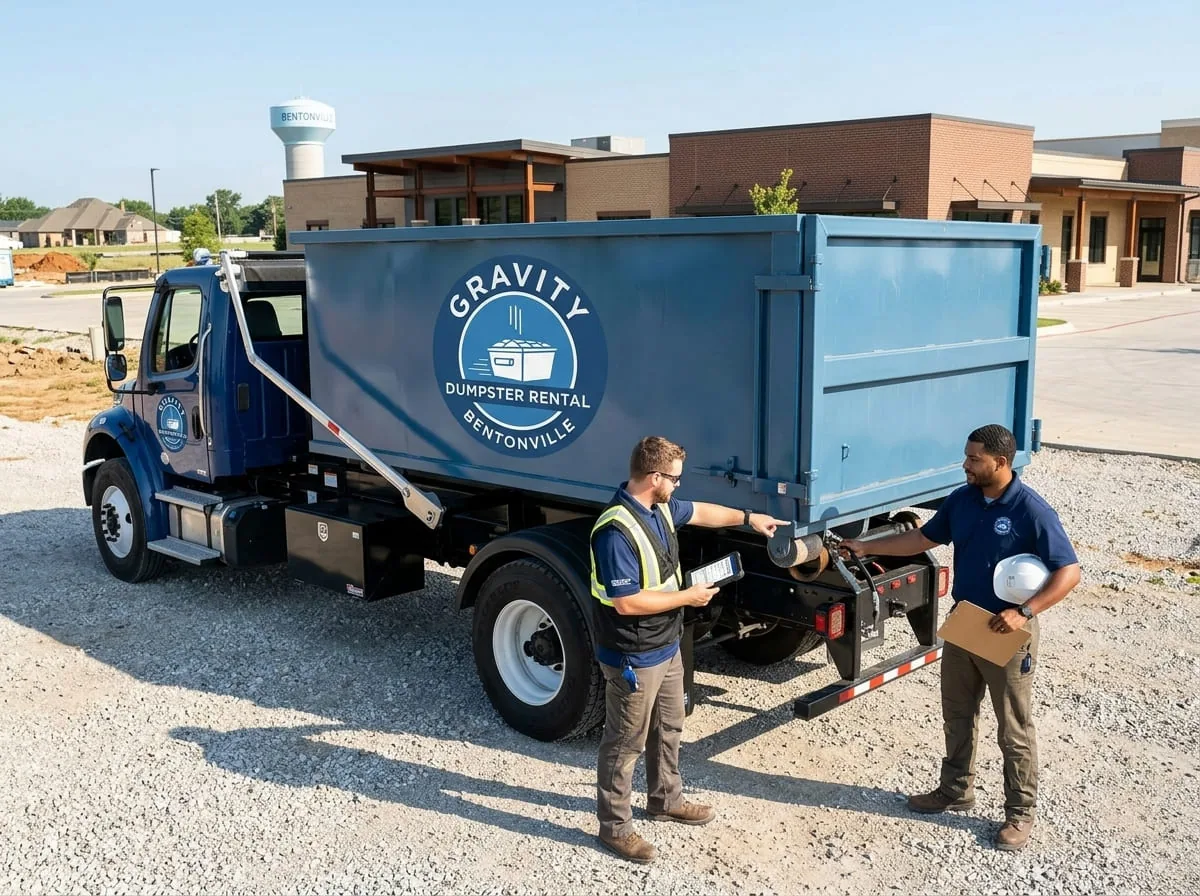
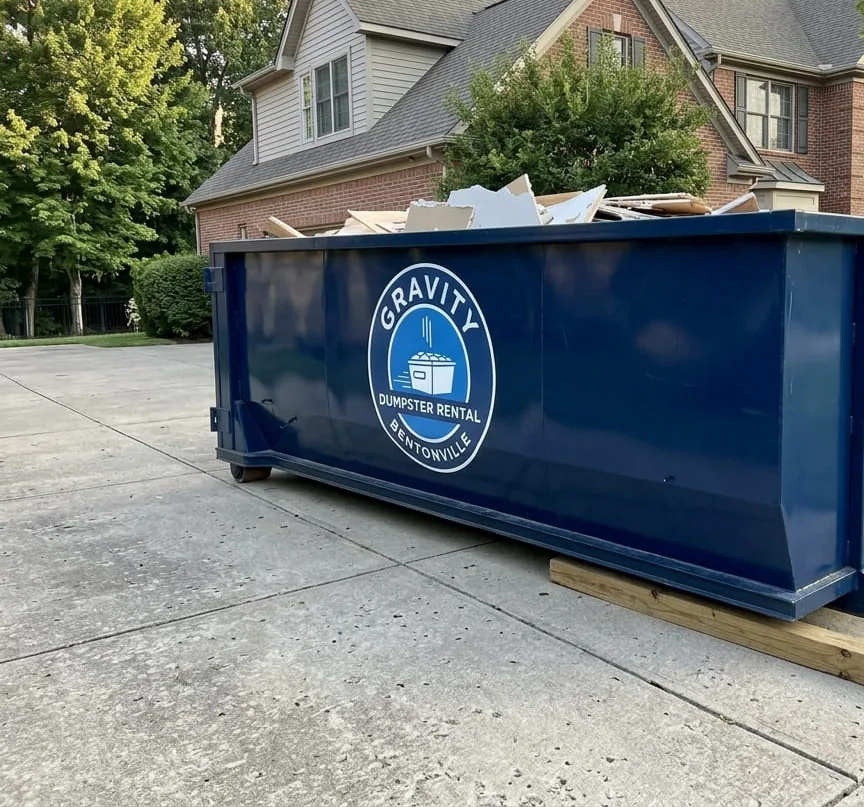
Drive out Highway 102 through Centerton on a Tuesday morning and you will pass several active framing sites before you hit Bella Vista. The same is true along the Rogers-to-Bentonville corridor and the new streets branching off Highway 71 south of downtown Bentonville. Northwest Arkansas has been building houses at a pace that outstrips most of the country for years running. For builders and homeowners managing a new-build project, that pace creates a problem most renovation jobs never face: debris that changes character every few weeks, on a schedule where a stalled dumpster stalls a crew.
A new-construction site is not a one-dumpster job. It is a sequence of waste streams — framing scrap, then drywall, then flooring and trim — each with its own volume and weight profile, on a timeline set by the trades ahead of you. Getting container size and swap cadence right at each phase keeps the site moving and the disposal line from creeping past what it should cost.
New-Home Construction Runs on a Different Debris Schedule Than a Remodel
A kitchen remodel or a whole-house renovation generates one mixed pile of demolition debris up front and then tapers off. A ground-up new build is the opposite: it starts light, builds toward a heavy middle, and tapers into a lighter finish wave. Site work and foundation prep produce relatively little — some tree clearing, form lumber, concrete packaging. Framing brings a sustained volume of lumber offcuts, sheathing scrap and shrink wrap. Drywall and insulation hit hardest mid-schedule, once the house is closed in but not yet finished. Flooring, trim, cabinetry and paint generate a final, lighter wave before the punch list.
Because each phase behaves differently, one container size ordered at the start of the job and left in place for months is almost always the wrong call — too small during framing and drywall, oversized and half-empty during finish-out. Planning swaps around the phases below is the more efficient approach on almost every build we deliver around Bentonville, Rogers, Centerton and Bella Vista.
Early Framing: Sizing for Lumber Offcuts and Packaging
Framing debris is bulky but not especially heavy — stud offcuts, sheathing cutoffs, banding, and the cardboard and plastic wrap that comes off engineered lumber and truss packages. It fills a container's volume fast without coming close to its weight allowance, the opposite problem builders run into later in the job. A 20-yard dumpster is the workhorse size for this phase on a typical single-family lot, with enough room to keep pace without crowding the site.
On a larger custom build or a home with a complicated roofline, framing crews can fill a 20-yard box faster than expected on volume alone. If the crew is running two or three weeks of continuous framing, discuss a scheduled swap rather than waiting for a call once the container is already overflowing. See the dumpster sizes page for the full range if the framing package is larger than average.
Mid-Build: Drywall, Rough-In and Insulation Debris
Once the house is dried in, drywall arrives — and drywall scrap is the phase most builders underestimate on weight. Cutoffs, corner scraps and the compound buckets that come with a hang-and-finish crew add up fast, and gypsum board is considerably denser than framing scrap. Insulation wrap, electrical and plumbing packaging, and blocking cutoffs from rough-in trades pile on top. This is typically the heaviest stretch of the build, and undersizing here costs the most in wasted trips and idle trades.
A 30-yard dumpster is the right call for most single-family homes during drywall and rough-in, with a swap scheduled to land as hang-and-finish wraps up. For larger homes, or when several rough-in trades are stacking debris in the same window, sizing up beats an overflowing box mid-week once you count the crew time lost.
Late Build: Flooring, Trim and Finish-Out Debris
The final stretch produces less volume overall, but it is a mix of materials — flooring scrap, trim cutoffs, cabinet and door packaging, paint cans, and general cleanup ahead of the walkthrough. Weight and volume both drop off compared to the drywall phase, which is why builders often step back down in size rather than keeping a 30-yard box parked half-empty through the punch list.
A 15-yard dumpster or 20-yard container generally covers finish-out and final cleanup on a standard single-family home. Scheduling that downsize deliberately, rather than leaving whatever sat on site during drywall, is one of the simpler ways to trim the disposal line without changing how the crew works.
Matching Container Size to Build Phase
The table below is a general planning guide for a standard single-family new build in the Bentonville, Rogers, Centerton and Bella Vista area. A larger home or compressed schedule can push any phase up a size.
Even a small amount of broken concrete, brick or block from foundation or flatwork corrections carries real weight — these materials run roughly 3,000 to 4,000 pounds per cubic yard, so a 10-yard box with a 1-2 ton allowance can reach its weight limit with only a shallow layer across the floor, well before the container looks full. Mention any flatwork corrections or footing spoil when ordering so the weight allowance matches the load.
Swap-Out Scheduling So a Full Container Never Stalls the Crew
The single biggest efficiency gain on a multi-month build is scheduling swaps ahead of need rather than reacting to a full container. A crew standing around because there is nowhere to throw debris is a direct cost — framers, drywall hangers and finish carpenters bill by the day whether the dumpster is empty or overflowing. Builders who get the most out of a rental treat the swap schedule like a material delivery: planned a few days ahead, not called in as an emergency.
A practical approach is to walk the site with the superintendent once a week during the heavier phases, estimate how many more days the current container has, and call ahead of that date. Same-day dumpster rental is available when a swap gets missed or a phase runs faster than expected, but it works best as a backup, not the default plan.
Multiple Containers for Larger Builds and Spec Home Rows
On a large custom home, a multi-lot spec build, or a subdivision phase with several houses under construction at once, a single dumpster rotating between framing and drywall debris often cannot keep pace. Running two containers — one for the active heavy-debris phase, a second for a different lot or waste stream — keeps material moving without crews waiting on each other. This is common on accounts running three or four homes at once through the same subdivision, staggering swap schedules by lot so every container does not need pickup the same day.
For builders managing several active addresses, a standing account with a consistent swap cadence per lot is generally more efficient than ordering each container as a one-off, and it makes disposal costs easier to track per house. The construction dumpster rental page has more on how that works for ongoing builder accounts.
Working Around an Active Jobsite: Staging, Trades and Unfinished Driveways
Placement is a bigger consideration on a new build than on most renovation jobs, since the site itself is unfinished. Often there is only a gravel pad or a rough-graded approach, with trade vehicles and deliveries competing for the same staging area.
- Confirm a firm, level spot before delivery day — a gravel pad near the street is usually more stable than soft graded soil after rain, since Ozark clay soil holds water and softens fast.
- Keep the container clear of the path concrete trucks, lumber deliveries and lift access need to swing, so it does not have to be moved mid-phase.
- Coordinate timing with other trades — a material delivery and a dumpster swap arriving at once on a single-lane approach is a common, avoidable bottleneck.
- Flag overhead lines or low tree cover near the placement spot in advance, since delivery trucks need real clearance to place and pick up a container safely.
Discussing the site layout when scheduling delivery — where the driveway will eventually go, where other trades are staging material, whether the approach is paved or still gravel — lets the driver plan the drop instead of improvising on arrival. The guide to dumpster placement and driveway protection covers more on siting a container around a structure still under construction.
Not everything on a framing or finish-out site needs to go in the main container. Clean scrap metal — HVAC duct cutoffs, wire spool ends, plumbing pipe scrap, rebar offcuts — has scrap value and is worth collecting separately in a bin or trailer rather than mixing it into general debris. On a build generating a meaningful volume of metal, a scrap hauler pickup can offset disposal costs directly.
Clean dimensional lumber offcuts are worth a similar look where the site has room for it. Unpainted, untreated framing scrap is a different disposal stream than general debris, and some sites separate it for reuse as blocking or bracing rather than sending it to the container. It will not work on a tight lot, but on a larger lot it reduces what needs to be hauled and disposed of. The EPA's overview of sustainable management of construction and demolition materials lays out the broader case for separating recoverable jobsite materials.
Before any excavation for footings, utility trenching or a septic line, call Arkansas 811 to have underground lines marked. It costs nothing and is required by law before digging — a separate step from dumpster placement, but worth building into the same pre-construction checklist.
Why NWA Builders Are Leaning on Dumpster Rental More Than Ever
The pace of new construction across Benton and Washington counties is not just a local impression. The U.S. Census Bureau has repeatedly ranked Northwest Arkansas among the fastest-growing metro areas in the country in recent years, and Benton County has ranked among the fastest-growing counties in the state, with Centerton named one of Arkansas's fastest-growing cities.
That growth traces largely to the region's corporate anchors — Walmart's headquarters in Bentonville, Tyson Foods in Springdale, and J.B. Hunt in Lowell — which continue to draw new residents and new construction. For builders, that means a steady pipeline of starts, but also more competition for the same crews, delivery windows and staging space. Planning debris removal around the build schedule, rather than whichever container happens to be available, is a controllable part of keeping a job on pace. Permit information for Bentonville is available through the city's plans and reports page, and for unincorporated Benton County through the county building safety department.
Whether the job is a single custom home on a wooded lot in Bella Vista or a run of spec houses going up together in a new Centerton subdivision, matching container size and swap timing to the actual build phase is what keeps the dumpster from becoming the bottleneck. We deliver and swap containers throughout Bentonville, Rogers, Centerton and Bella Vista, and work with builders on standing swap schedules rather than one-off orders. For what belongs in a construction container, see the guide to what can and cannot go in a dumpster in Arkansas, and for right-of-way placement, the NWA dumpster permit guide.
Ready to line up container sizing and a swap schedule for a new build? Call (479) 364-6780 to talk through the phases of your project, or reach out through the contact page and we will help plan delivery around your framing, drywall and finish-out schedule.